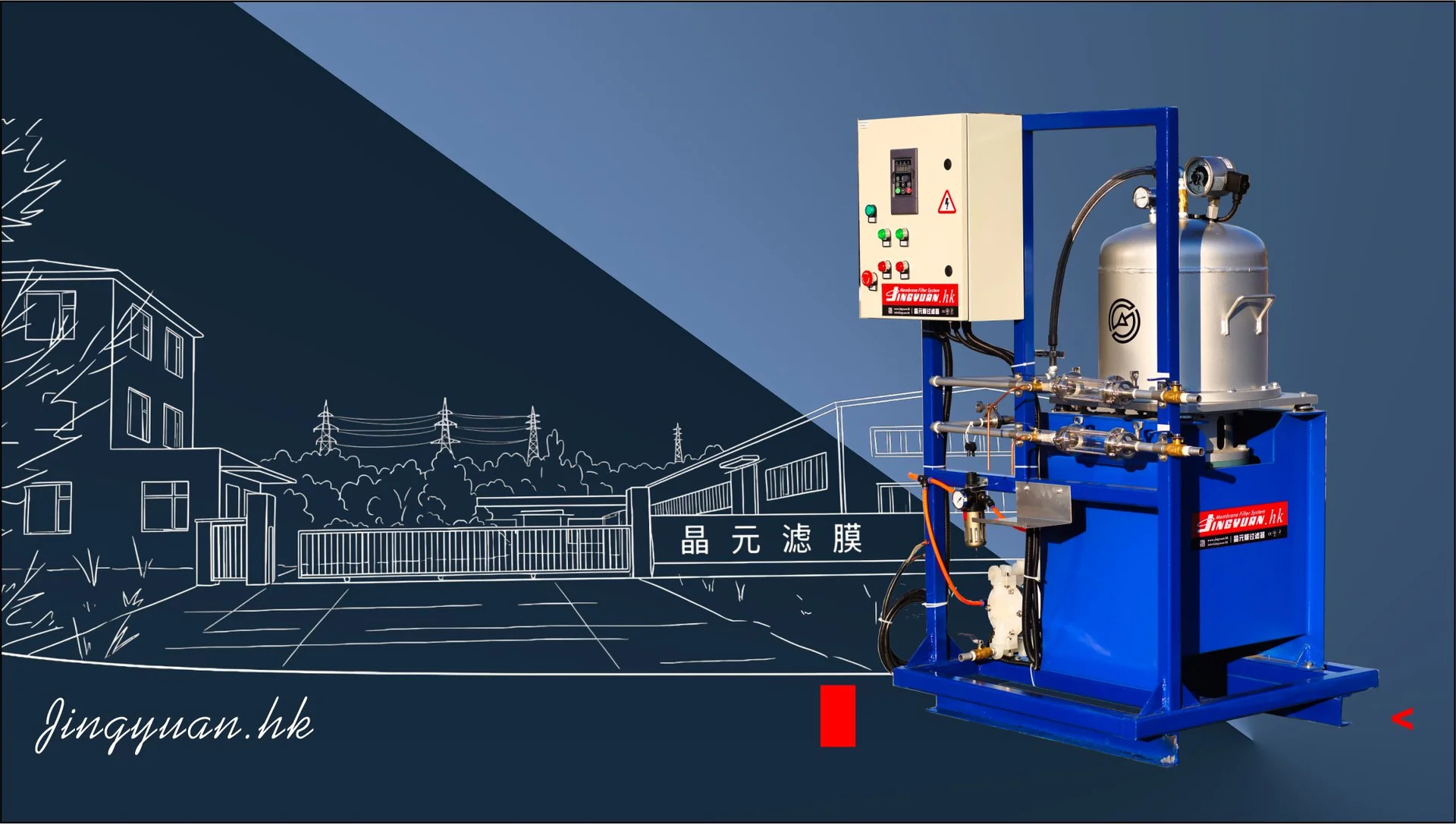
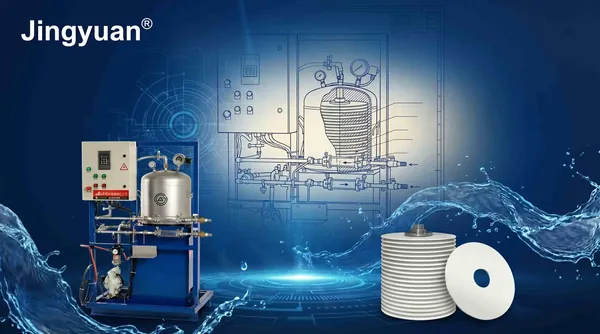
JY-DCF7 Dynamic Shear Enhanced Filtration System — Rotating Membrane Disc Dynamic Microfiltration Unit
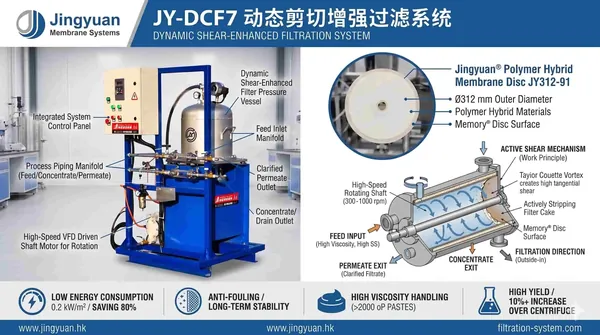
The JY-DCF7 is a Taylor-Couette dynamic shear filtration system rated 7 m³/h, using rotating cylinder geometry to generate controlled shear at 0.2 kW/m² energy density. CIS rigid membrane achieves 2 μm absolute filtration with simultaneous water and particulate removal, designed for high-viscosity lubricant and bio-oil conditioning applications.
Traditional static microfiltration and cross-flow membrane systems are prone to concentration polarization and rapid cake-layer buildup when processing high-concentration, high-viscosity and high-suspended-solids materials, causing sharp flux decay, high energy consumption and frequent cleaning.
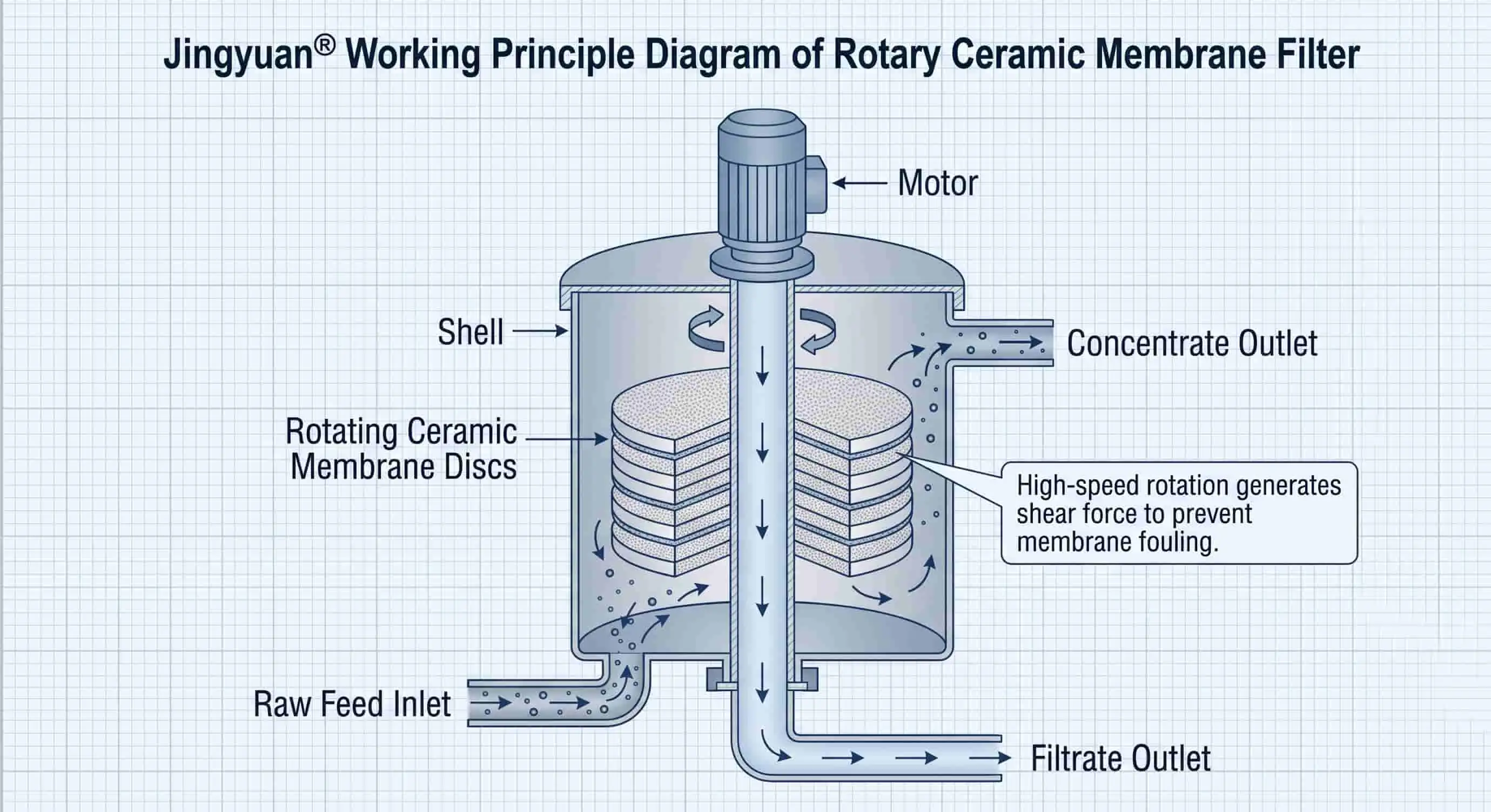
JY-DCF7 uses disruptive dynamic shear technology. Its JY312-91 polymer hybrid membrane disc rotates at 300–1000 rpm, actively generating high-intensity Taylor-Couette vortex shear on the membrane surface to continuously strip the cake layer and suppress fouling.
The system provides 15m² effective filtration area with only a 4.0kW drive motor, and total energy consumption is ≤0.3 kW/m², about one fifth of a conventional cross-flow system. It balances high flux, long-cycle stability and low energy use in biopharma, catalyst recovery and high-SS wastewater treatment.
What are the critical performance parameters for this filtration system?
What is this filtration system and how does it work?
Traditional static microfiltration and cross-flow membrane systems are prone to concentration polarization and rapid cake-layer buildup when processing high-concentration, high-viscosity and high-suspended-solids materials, causing sharp flux decay, high energy consumption and frequent cleaning.
JY-DCF7 uses disruptive dynamic shear technology. Its JY312-91 polymer hybrid membrane disc rotates at 300–1000 rpm, actively generating high-intensity Taylor-Couette vortex shear on the membrane surface to continuously strip the cake layer and suppress fouling.
The system provides 15m² effective filtration area with only a 4.0kW drive motor, and total energy consumption is ≤0.3 kW/m², about one fifth of a conventional cross-flow system. It balances high flux, long-cycle stability and low energy use in biopharma, catalyst recovery and high-SS wastewater treatment.
Which industrial applications require this specific filtration system?
Biopharmaceutical fermentation broth clarification
Efficiently separates cells, improves target product recovery by about 10% versus disc-stack centrifuges, meets GMP requirements and avoids product loss.
Micron-scale catalyst recovery
Efficiently recovers Pd/C, Ni and other catalyst particles while enabling solid-liquid separation and soluble impurity washing.
High-SS environmental wastewater concentration
Works as a front-end unit for ZLD processes, reducing the load on downstream RO/NF systems.
Food and beverage clarification filtration
Used for sugar liquor, juice and similar clarification or microbial reduction to improve final product purity and quality.
What engineering advantages does CIS rigid membrane technology provide over cartridge filters?
Active dynamic shear anti-fouling technology
High-speed membrane disc rotation creates strong shear that fundamentally suppresses concentration polarization and cake buildup, maintaining continuous high flux far better than static or conventional cross-flow membrane systems.
Polymer hybrid membrane disc
An asymmetric porous structure with hydrophilic modification combines mechanical strength, hydrophilicity and chemical tolerance, delivering 2–15 μm nominal retention and ≥99.5% retention efficiency.
Ultra-low-energy green design
Total energy consumption is about one fifth of traditional cross-flow systems, reducing long-term operating cost while gentle shear protects sensitive materials such as cells and proteins.
What are the complete technical specifications and engineering parameters?
| Parameter | Specification | Note |
|---|---|---|
| Model | JY-DCF7 | Dynamic shear system |
| Effective filtration area | 15 m² | Standard configuration |
| Drive motor power | 4.0 kW (380V/50Hz/3Ph) | Low energy |
| Membrane disc speed | 300 ~ 1000 rpm (VFD stepless adjustment) | Active shear |
| Retention precision | 2 / 5 / 15 μm optional | Microfiltration grade |
| Retention efficiency | β ≥ 200 (efficiency ≥99.5%, ISO 16889) | High precision |
| Transmembrane pressure (TMP) | 0.1 ~ 0.25 MPa | Gentle operation |
| Maximum operating temperature | 80°C | Temperature resistance |
| pH tolerance | 2 ~ 12 | Broad compatibility |
| Overall energy consumption | ≤ 0.3 kW/m² | Ultra-low |
| Dimensions | 980 × 1030 × 1550 mm | Compact |
| Dry weight | Approx. 650 kg | Industrial grade |
What industry standards and certifications does this system comply with?
- Filtration performance based on ISO 16889
- pH tolerance 2–12 and maximum temperature 80°C
- Rotating equipment safety interlock protection
- Mechanical seal with barrier-fluid system
- Optional explosion-proof motor (Ex d IIB T4)
- Cleaning waste liquid and concentrate should be disposed according to hazardous-waste rules
FAQ
What advantages does JY-DCF7 have over traditional cross-flow membranes?
Active shear prevents fouling, stabilizes flux and uses only about one fifth of the energy of conventional systems.
How is membrane disc speed adjusted?
The speed is continuously adjustable from 300–1000 rpm via VFD, allowing shear force to be optimized for different materials.
What materials is it suitable for?
It is designed for high-concentration, high-viscosity and high-SS materials such as fermentation broth, catalyst slurry and high-suspended wastewater.
Can it process nanoscale particles?
It belongs to the microfiltration (MF) category and cannot retain nanoscale particles (<100nm) or dissolved small molecules; NF/RO should be used downstream if needed.
Can the membrane disc be cleaned and regenerated?
Yes. Chemical cleaning is supported to extend service life and reduce consumable cost.
What safety protection does the system include?
It includes protective covers and electrical interlocks. Dry running is prohibited, and a mechanical seal barrier-fluid system is required.
Is explosion-proof configuration available?
Yes. Ex d explosion-proof motor and control cabinet can be selected for flammable solvent scenarios.
Related products
Discuss this model
Contact us for JY-DCF7 pilot testing, process design and a detailed quotation.
We provide turnkey service from material analysis and membrane selection to installation, commissioning and GMP validation support.