The Hidden Threat in Data Center Diesel Storage: Why Fuel Polishing Cannot Be Ignored
For Tier III/IV data centers, diesel generators are the last line of power defense. However, most operations teams focus attention on UPS, generator units, and automatic transfer systems, while neglecting diesel quality management in storage tanks.
Fuel degradation is the inevitable result of long-term storage. After 6–12 months of static storage in tanks, diesel undergoes triple degradation: oxidative polymerization, microbial growth, and moisture accumulation. Uptime Institute research indicates that approximately 30% of diesel generator startup failures are directly related to fuel contamination rather than mechanical failure.
Cleanliness standards are extremely stringent. Data center diesel typically requires ISO 4406 14/12/9 or higher, with free water content ≤ 50 ppm. This standard far exceeds ordinary industrial diesel (ISO 18/16/13), because high-pressure common-rail fuel injector precision clearances are only 2–5 μm, and any oversized particles can cause irreversible wear.
Maintenance windows are extremely narrow. Large data centers typically are equipped with 50,000–200,000 liter diesel storage tanks. Traditional manual fuel extraction and filtration or offline purification requires 8–24 hours of shutdown, which is almost unacceptable in a 7×24 operations environment.
Three Mechanisms of Diesel Storage Degradation and Their Hazards
| Degradation Mechanism | Trigger Conditions | Typical Time Scale | Hazard to Generator |
|---|---|---|---|
| Oxidative Polymerization | High temperature, light exposure, metal catalysis | 3–6 months | Increased acid number, gum clogging injectors, increased carbon deposits |
| Microbial Growth | Free water + temperature 15–35°C | 1–3 months | Biofilm clogging filters, acid production corroding tank and piping |
| Moisture Accumulation | Condensation, temperature fluctuation | Continuous accumulation | Free water corroding high-pressure pump, emulsification reducing combustion efficiency |
Limitations of Traditional Fuel Maintenance Methods
Current diesel maintenance methods commonly used in data centers include periodic fuel extraction and testing, manual tank cleaning, offline filtration, and chemical additives. Each has obvious limitations.
Periodic Testing Is Passive and Lagging — Quarterly or semi-annual sampling and testing can only discover problems that have already occurred, unable to prevent degradation. When test reports show excessive acid number, the entire tank of fuel is often already unusable.
Manual Tank Cleaning Is Expensive — Tank cleaning operations require emptying fuel, entering confined spaces, and handling oil-containing sludge, costing RMB 30,000–80,000 per tank, at least 1–2 times per year.
Offline Filtration Affects Operations — Extracting fuel for filtration before returning it requires shutdown coordination, meaning complete loss of backup power window for data centers.
Chemical Additives Only Address Symptoms — Biocides only temporarily inhibit microorganisms, unable to remove formed biofilms and oxidation products; long-term use also alters fuel chemical properties, bringing unknown risks.
Online Kidney-Loop Polishing: Keeping Storage Tank Diesel 'Forever Young'
Jingyuan fuel polishing systems adopt 24/7 kidney-loop strategy, extracting fuel from tank bottom, passing through rigid membrane precision filtration and hydrophobic phase separation, then returning clean fuel to tank top. This closed-loop design requires brief 5-15 min safety pause and continuously maintains fuel quality.
βₓ ≥ 200 high-efficiency capture Ratio — The system employs high-density high-polymer rigid membrane arrays, with high-efficiency capture ratio βₓ ≥ 200 (ISO 16889), single-pass retention efficiency ≥ 99.5%. Only 1 out of every 200 particles larger than the rated pore size can penetrate.
Hydrophobic Phase Physical Separation — Membrane surface oleophilic-hydrophobic modification physically repels water molecule coalescence, stably controlling free water at ≤ 50 ppm without demulsifiers. This is particularly important for long-term storage environments because water molecules are a necessary condition for microbial growth.
Gas-Pulse Regeneration — When trans-membrane differential pressure reaches threshold, the system automatically triggers N₂ pressurization → pulse release, entire process 5-15 min safety pause, with post-regeneration flux recovery ≥ 90%. Compared to disposable cartridges requiring shutdown for replacement, regeneration achieves minimal-downtime maintenance (brief 5-15 min safety pause).
≥ 3-Year Membrane Life — Rigid membrane elements feature a non-consumable structure, with life ≥ 3 years under normal operating conditions. For a 100,000 liter tank, continuous operation for 3 years can save RMB 150,000–300,000 in cartridge replacement costs while eliminating used cartridge hazardous waste disposal burden.
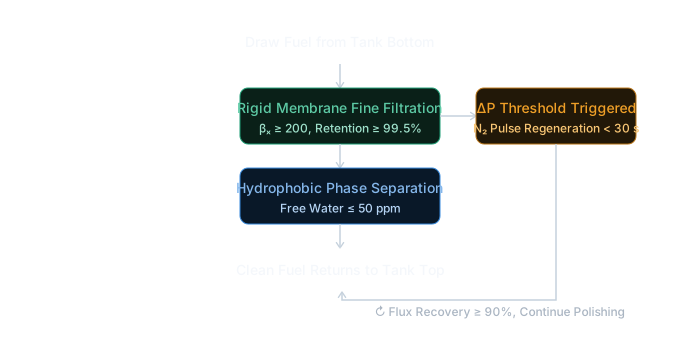
24/7 kidney-loop closed circuit: extract from tank bottom → rigid membrane precision filtration → hydrophobic phase separation → return clean fuel to tank top; automatic N₂ pulse regeneration triggered when differential pressure exceeds threshold
3-Year Operations Cost Comparison: Online Polishing vs. Traditional Maintenance
| Cost Item | Traditional Maintenance Solution | Jingyuan Online Polishing Solution |
|---|---|---|
| Initial Equipment Investment | 0 (no fixed equipment) | RMB 180,000–300,000 |
| Cartridge/Additive Costs | RMB 60,000–120,000/year | ≈ 0 (no consumables) |
| Manual Tank Cleaning Cost | RMB 30,000–80,000/time × 4–6 times | ≈ 0 |
| Offline Filtration Downtime Loss | 8–24 hours each time | Brief 5-15 min safety pause required |
| Fuel Scrap Loss | Full tank replacement RMB 100,000–300,000 | ≈ 0 |
| 3-Year Total Cost | Approx. RMB 400,000–1,000,000 | Approx. RMB 200,000–350,000 |
| Fuel Quality Stability | High fluctuation, dependent on sampling | Continuous online stability |
Jingyuan Data Center Fuel Polishing Product Selection
For different scale data centers and generator configurations, Jingyuan provides dedicated fuel polishing equipment:
JY-DF15 · Fuel Deep Purification System (IDC Version)
Applicable:Large data center diesel generator storage tanks, hospitals, communication base stations
Highlights:100 high-density rigid membrane arrays, 24/7 kidney-loop continuous polishing; free water ≤ 50 ppm; Tier III/IV compliance support; minimal-downtime maintenance (brief 5-15 min safety pause)
JY-DX40 · Skid-Mounted Membrane Separation Precision Filtration System
Applicable:Regional data centers, backup tank farms, centralized fuel supply stations
Highlights:8 membrane modules, 30-second fast backwash; skid-mounted design for easy field deployment; high flow meets multi-tank parallel circulation demand
JY-DX5 · Multi-Function Compact Skid-Mounted Precision Filtration System
Applicable:Small and medium data centers, edge computing nodes, distributed energy storage
Highlights:Compact volume, low energy consumption; dehydration + decontamination integrated; suitable for space-limited small machine rooms
Customer Cases: From Edge Computing to Hyperscale Data Centers
Jingyuan fuel polishing systems have been validated in various data center scenarios:
Modern Core Farm in Northeast China
Challenge:Central tank farm breathing contamination, tank bottom sludge accumulation, multiple transfer links
Solution:10 m³/h skid-mounted precision filtration system + JY-219A mobile equipment, hierarchical purification strategy
Result:Tank cleaning cycle significantly extended; internal fuel consistently maintained within ISO 15/13/10; no further downtime incidents caused by fuel quality
Petroleum Company in Ningxia
Challenge:Tanker unloading secondary contamination, long-term static storage causing quality degradation
Solution:JY-DX40 40 m³/h inlet-end purification, two-stage precision filtration
Result:Tank bottom impurity sediment significantly reduced; dispenser maintenance frequency clearly decreased; oil quality became marketing selling point
Data Center Fuel Polishing Frequently Asked Questions
Does polishing affect diesel generator fuel supply?
No. Jingyuan polishing systems adopt an independent kidney-loop circuit, operating in parallel with generator fuel supply lines. Polishing flow is only 5–10% of tank total capacity per day, not affecting the main fuel supply system. When the generator starts, the polishing system automatically reduces speed or pauses, prioritizing fuel supply.
How long does the polishing system take to restore degraded diesel to qualified levels?
Depends on initial contamination level and tank capacity. For a 100,000 liter tank, if initial cleanliness is ISO 20/18/15, using JY-DF15 (10 m³/h) continuous operation for 48–72 hours typically improves cleanliness to within ISO 14/12/9.
When microbial contamination is severe, can the polishing system handle biofilm?
Rigid membranes with absolute pore size ≥ 2 μm can effectively retain microbial colonies and biofilm fragments. However, for severe biological contamination (thick biofilm already attached to tank walls), chemical cleaning is recommended first, followed by long-term maintenance with the polishing system. The core value of polishing systems lies in continuously inhibiting microbial regrowth.
What is the cost and workload of membrane element replacement after 3 years?
JY-DF15 membrane element module replacement cost is approximately 20–30% of total machine price, with replacement workload of about 4–8 hours, no special tools required. Compared to 3-year cumulative cartridge replacement costs (typically 2–3 times machine price), membrane element replacement still has obvious cost advantage after year 3.
Do different Tier level data centers have different requirements for fuel polishing?
Tier III/IV data centers typically require fuel cleanliness to reach ISO 4406 14/12/9 or higher, with 7×24 monitoring capability. Jingyuan JY-DF15 is specifically designed for high-tier data centers, supporting remote differential pressure monitoring and automatic regeneration alarms, meeting Tier III/IV operations compliance requirements.
What is the recommended fuel polishing cycle for data center diesel?
For mission-critical data center applications, 24/7 continuous kidney-loop polishing is the gold standard. The polishing system circulates 5-10% of tank volume per day, maintaining fuel quality indefinitely. For non-critical applications, quarterly polishing at 2-3x tank volume is the minimum recommended frequency.
How does fuel polishing handle biodiesel blends (B20-B50)?
CIS rigid membrane hydrophobic separation remains stable in B50 biodiesel at temperatures up to 80°C. Biodiesel absorbs up to 20x more water than petrodiesel, making integrated water removal critical. The membrane physically repels water without demulsifiers, performing reliably even with high biodiesel content.
What ISO 4406 cleanliness level should data center diesel maintain?
Tier III/IV data centers should maintain ISO 4406 14/12/9 or better. This means: no more than 64 particles ≥4 μm, 32 particles ≥6 μm, and 10 particles ≥14 μm per 1 mL of fuel. This standard far exceeds ordinary industrial diesel (ISO 18/16/13) because HPCR injector clearances are only 2-5 μm.
Can fuel polishing restore fuel that has already degraded?
Yes, if degradation hasn't passed the point of no return. For a 100,000-liter tank with initial cleanliness ISO 20/18/15, JY-DF15 (10 m³/h) continuous operation for 48-72 hours typically restores cleanliness to ISO 14/12/9. However, severely degraded fuel with high acid number or thick biofilm may require chemical pre-treatment.
What is the power consumption of a fuel polishing system?
JY-DF15 consumes approximately 1.5 kW continuous — equivalent to a small household appliance. For a 100,000-liter tank running 24/7, annual electricity cost is typically under $2,000, which is negligible compared to the $150,000-300,000 in cartridge replacement costs it replaces.
How does the gas-pulse regeneration work?
When trans-membrane differential pressure reaches a preset threshold, the system automatically triggers N₂ pressurization (0.5 MPa) followed by pulse release. The entire process takes less than 30 seconds and requires brief 5-15 min safety pause. Post-regeneration flux recovery is ≥90%. N₂ consumption is minimal — less than 0.5 kg per cycle.
What happens if the polishing system fails during operation?
The polishing system operates in parallel with the generator fuel supply, so a polishing system failure does not affect generator operation. The system includes differential pressure alarms and remote monitoring capabilities. If the system stops, fuel quality will gradually degrade over weeks (not hours), providing ample time for maintenance response.
Is the polishing system compatible with remote monitoring?
Yes. JY-DF15 supports remote differential pressure monitoring, automatic regeneration alarms, and operating status logging. This meets Tier III/IV data center compliance requirements for 7×24 monitoring and audit trail documentation.
What maintenance does the polishing system require annually?
Annual maintenance is minimal: (1) inspect membrane module differential pressure trends, (2) verify sensor calibration, (3) check N₂ supply pressure, (4) inspect piping and valves for leaks. No cartridge replacement is needed — the rigid membrane elements have a 3+ year service life.
How does the system handle microbial contamination?
CIS rigid membranes with absolute pore size ≥2 μm effectively retain microbial colonies and biofilm fragments. For severe contamination (thick biofilm on tank walls), chemical cleaning is recommended first, followed by long-term polishing maintenance. The system's core value is continuously inhibiting microbial regrowth by removing water — the necessary condition for microbial growth.
What is the ROI timeline for a data center fuel polishing system?
Typical ROI is 12-18 months. For a 100,000-liter tank, the system costs RMB 180,000-300,000 upfront but saves RMB 150,000-300,000 over 3 years in cartridge replacement, manual tank cleaning, and fuel scrap costs. After year 3, membrane element replacement costs only 20-30% of machine price.
Can the polishing system be retrofitted to existing fuel storage tanks?
Yes. The kidney-loop design requires only two connections to the existing tank: a suction line from the tank bottom and a return line to the tank top. Installation typically takes 1-2 days with no need to empty the tank. The system can be skid-mounted for easy deployment.
What water content level should data center diesel maintain?
Free water content should be maintained at ≤50 ppm. Water in diesel causes corrosion of tanks and piping, promotes microbial growth at the fuel-water interface, reduces lubricity, and damages high-pressure fuel pumps. Jingyuan's hydrophobic membrane separation physically repels water without chemical demulsifiers.
How does fuel polishing compare to chemical biocides?
Chemical biocides only temporarily inhibit microorganisms — they cannot remove existing biofilms or oxidation products, and long-term use alters fuel chemical properties. Fuel polishing physically removes water, microbes, and contaminants without adding chemicals, making it a more sustainable and reliable long-term solution.
What certifications and standards does the polishing system comply with?
The system complies with ISO 16889 filtration testing (β≥200), ISO 4406 cleanliness coding, and supports Tier III/IV data center compliance requirements. The manufacturing facility is ISO 9001 certified. Systems can be configured for hazardous area classification (Ex-proof) when required.
Download Technical Documents
Download PDF materials for product selection, technology briefs, and industry application guides.
PDF download requires email registration. Your information will be used only to send you the guide and related technical updates.